
Designing for Trust
Credentialed vs Trusted Physicians
Driving Early Engagement into Long-Term Contribution
DocMatter Platform
The Problem
DocMatter had successfully onboarded thousands of credentialed physicians to their healthcare collaboration platform but faced a critical conversion challenge. While doctors were creating accounts and asking their first questions, the majority weren't returning to contribute answers or build their professional presence on the platform.
The core issue was a cold-start problem: without visible reputation signals, new physicians couldn't assess the credibility of content or contributors. This created a cycle where lack of trust signals prevented engagement, which in turn prevented more conversation.
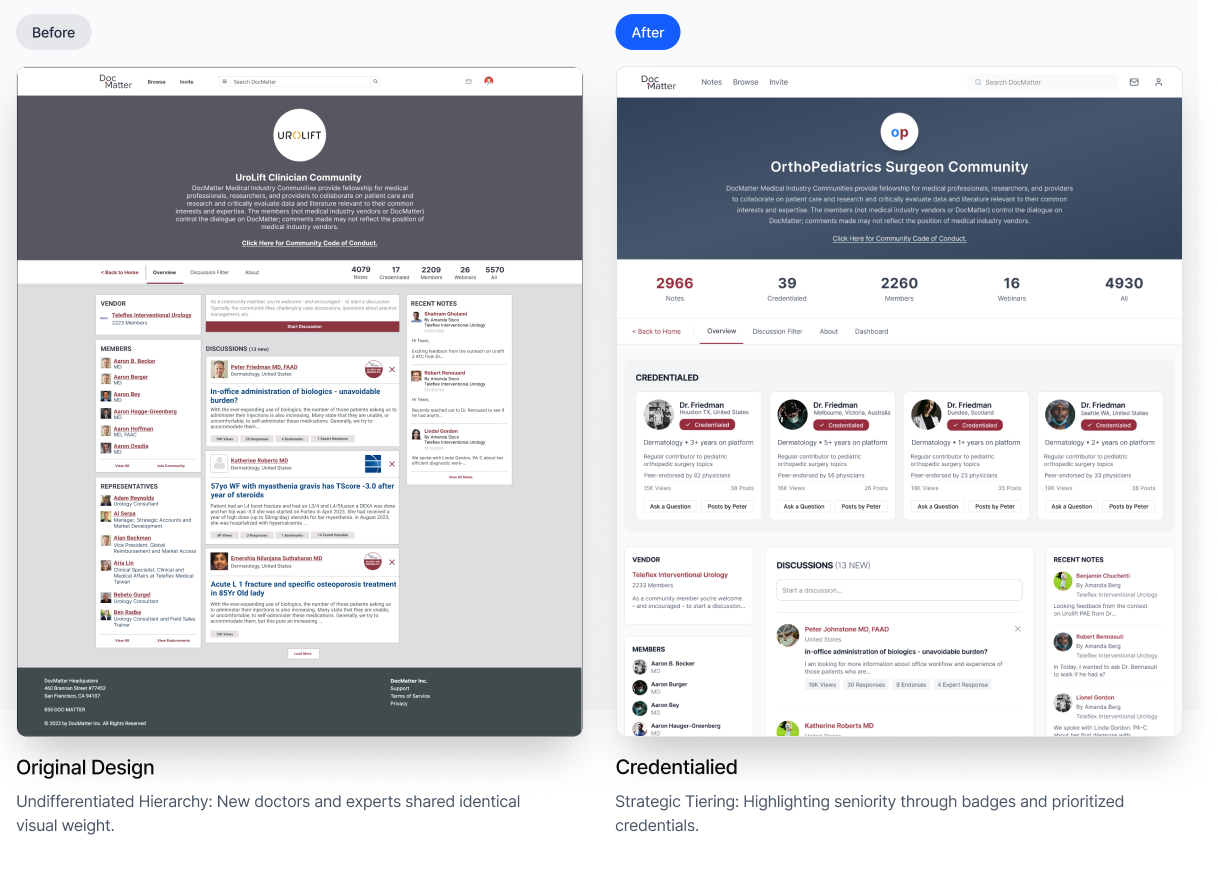
The "Before" State: Strategic Ambiguity
The platform lacked clear reputation signals, leaving subject matter experts indistinguishable from new doctors. Without visible trust indicators, physicians struggled to assess content credibility. This lack of transparency created a significant barrier to meaningful professional engagement and knowledge sharing.
The "After" State: Defined Authority
With the integration of Reputation Signals, expertise is now quantifiable and immediately visible. Verified credentials and peer-validated "trust scores" allow physicians to filter for high-signal content instantly. By surfacing true subject matter experts, the platform has transformed from a generic forum into a high-trust clinical network, driving deeper engagement and more reliable medical discourse.
My Role
As Lead Product Designer, I was responsible for designing and shipping a reputation system that would encourage physician participation while maintaining professional credibility standards. I led the end-to-end design process, from research and strategy through implementation and iteration.
I worked cross-functionally with product management, engineering, compliance, and physician stakeholders to balance business objectives, technical constraints, and professional norms in the medical community.
Research & Strategy
I began by conducting user interviews with 15 credentialed physicians to understand their motivations, concerns, and behaviors on the platform. Three critical insights emerged:
- Professional Identity: Physicians wanted recognition for their expertise but were wary of systems that felt competitive or "gamified" in ways inconsistent with medical professionalism.
- Content Quality Concerns: Doctors were hesitant to engage when they couldn't verify the credentials or expertise of other contributors.
- Lightweight Participation: The most successful engagement came from small, incremental actions rather than large time commitments.
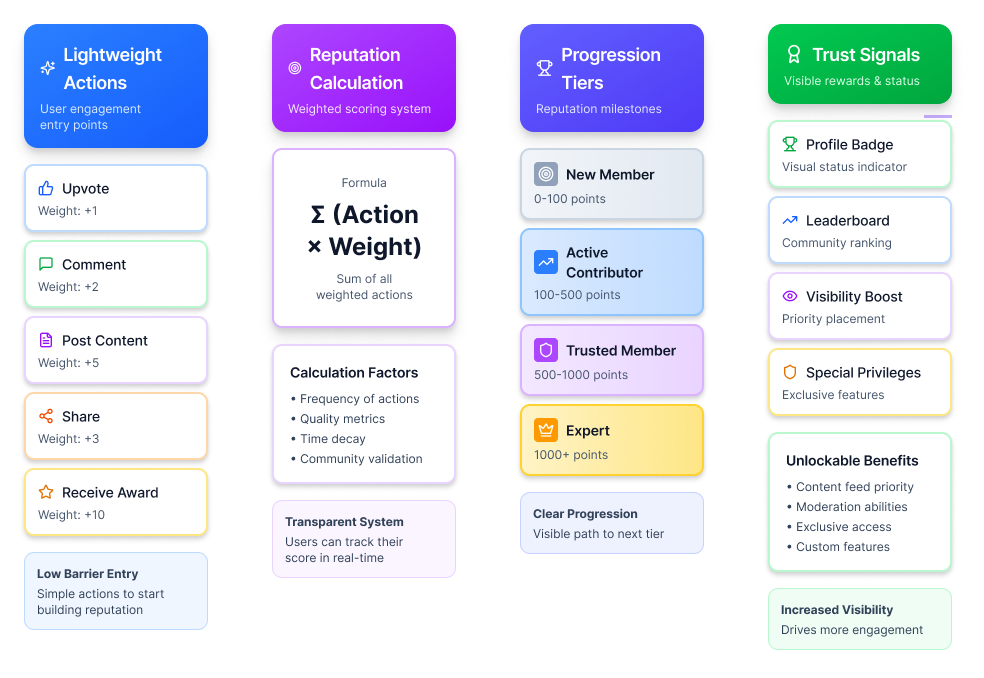
Systems Thinking — The Reputation Engine Framework
This system map demonstrates how lightweight physician actions feed into a reputation calculation engine that outputs trust signals throughout the platform. The feedback loop shows how increased visibility drives further engagement, creating a virtuous cycle. This was the strategic framework that guided all design decisions.
Based on this research, I developed a strategy centered on creating a lightweight reputation system that would:
Make Expertise Visible
Surface credentials and contribution history to help physicians assess credibility at a glance.
Reward Small Actions
Credit incremental contributions to lower the barrier to participation.
Maintain Professionalism
Use tiered levels rather than competitive scoring to align with medical culture.
The Core Insight
The breakthrough came from reframing the problem. Rather than thinking about "how to get doctors to contribute more," I asked: "What's preventing them from recognizing the value of contributing?"
Physicians weren't resistant to participation—they were risk-averse about engaging with unverified sources. By making expertise and contribution visible through a reputation system, we could create the trust foundation needed for sustained engagement.
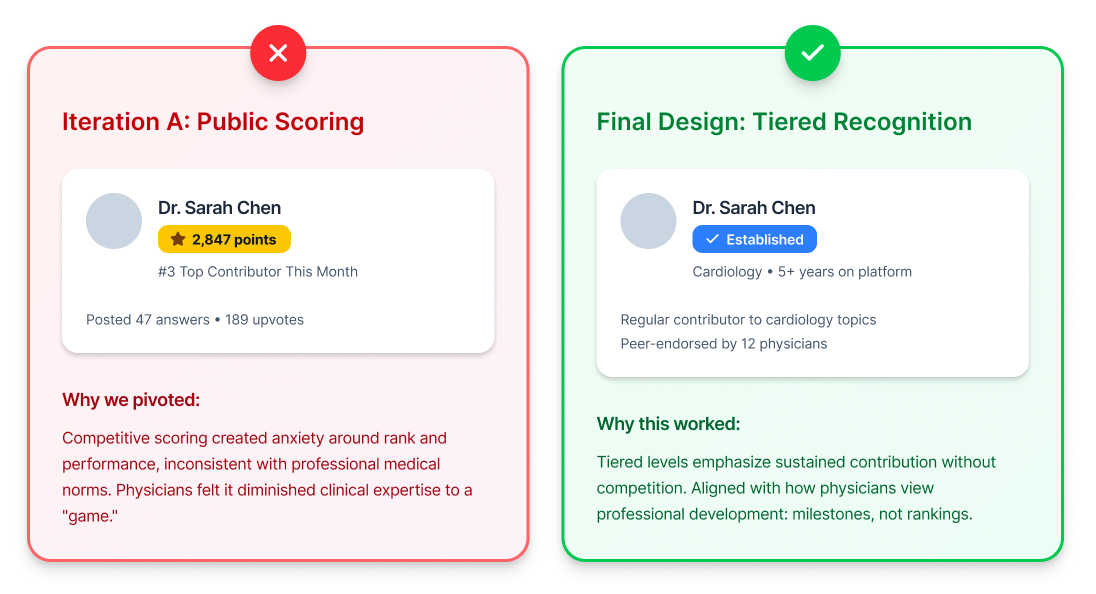
Design Judgment — Exploring and Rejecting Competitive Models
Early explorations tested a public scoring system with rankings and leaderboards. Through physician feedback, we learned this approach created professional discomfort and felt reductive of medical expertise. The pivot to tiered recognition maintained motivation while respecting the collaborative, non-competitive culture of medicine.
The Solution
I designed a three-tiered reputation system that made physician expertise and contribution visible throughout the platform:
1. Physician Profile Enhancements
I redesigned profile pages to prominently display credentials, specialties, and contribution tier. The tier badge ("Active," "Contributing," "Established") appeared next to the physician's name across all touchpoints, creating immediate credibility signals.
2. Lightweight Contribution Tracking
The system credited physicians for small actions: answering questions, endorsing peers, completing their profile, and engaging with content. This lowered the participation threshold while still rewarding meaningful contribution.
3. Trust Signals in Context
Reputation indicators appeared where they mattered most—next to answers, in search results, and in Q&A threads. This helped physicians quickly assess the credibility of content without requiring active investigation.
Implementation & Collaboration
Shipping this system required navigating significant cross-functional constraints and stakeholder concerns.
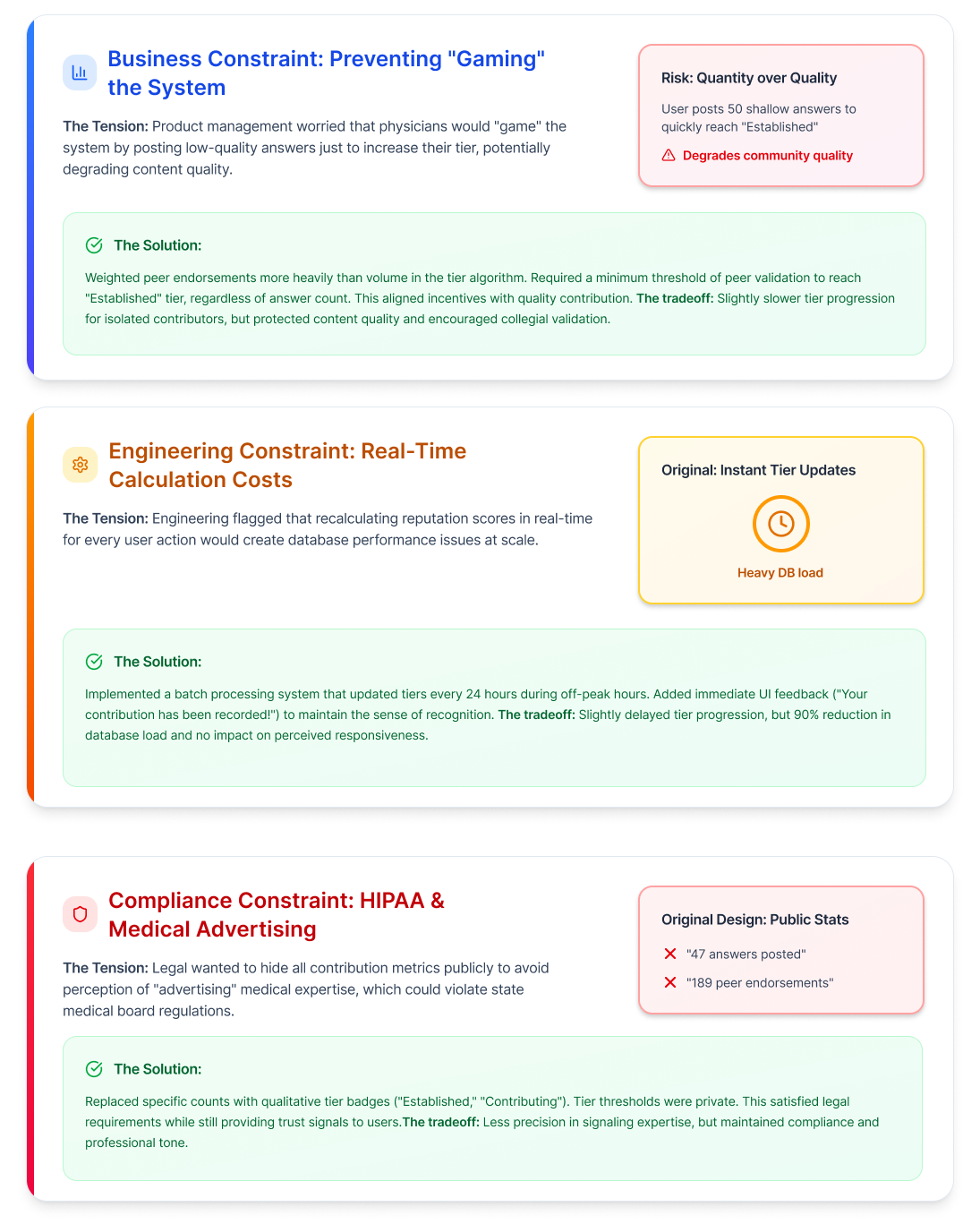
Stakeholder Tension — Navigating Cross-Functional Constraints
Shipping the reputation system required balancing competing priorities from Legal, Engineering, and Product teams. Each tradeoff required understanding the root concern, proposing alternatives, and building consensus around solutions that preserved user value while addressing stakeholder needs. These decisions shaped the final system architecture.
Throughout implementation, I worked closely with:
- Engineering to design a batch processing system that updated reputation tiers efficiently without impacting platform performance
- Legal/Compliance to ensure reputation signals didn't create liability around medical advertising or create perception of endorsed medical advice
- Product to define tier thresholds and weighting algorithms that balanced accessibility with meaningful differentiation
- Physician Advisory Board to validate that the system felt appropriate and motivating for the medical community
Results & Impact
The reputation system launched in Q2 2023 and showed immediate positive impact on physician engagement and platform health.
The system also revealed interesting behavioral patterns: physicians who received their first peer endorsement were 4.1x more likely to contribute a second answer within 7 days, suggesting that social validation was a key driver of continued engagement.
Key Learnings
This project reinforced several important lessons about designing for professional communities:
1. Culture Shapes Motivation
What works in consumer social products doesn't always translate to professional contexts. Physicians responded to recognition systems that aligned with medical culture—collaborative, milestone-based, and expertise-focused—rather than competitive leaderboards.
2. Trust Is a System, Not a Feature
Building trust required more than adding badges to profiles. It required thinking systematically about how credibility signals could appear at the right moments to influence decision-making throughout the user journey.
3. Start Small, Prove Value
Rather than building a complex multi-dimensional reputation system upfront, we started with a simple three-tier model that proved the concept. This allowed us to iterate based on real user behavior rather than assumptions.
4. Constraints Drive Better Design
The constraints from Legal and Engineering ultimately led to a better product. The shift from numerical scores to tiered levels made the system feel more professional, and the batch processing approach created space for quality thresholds that prevented gaming.